
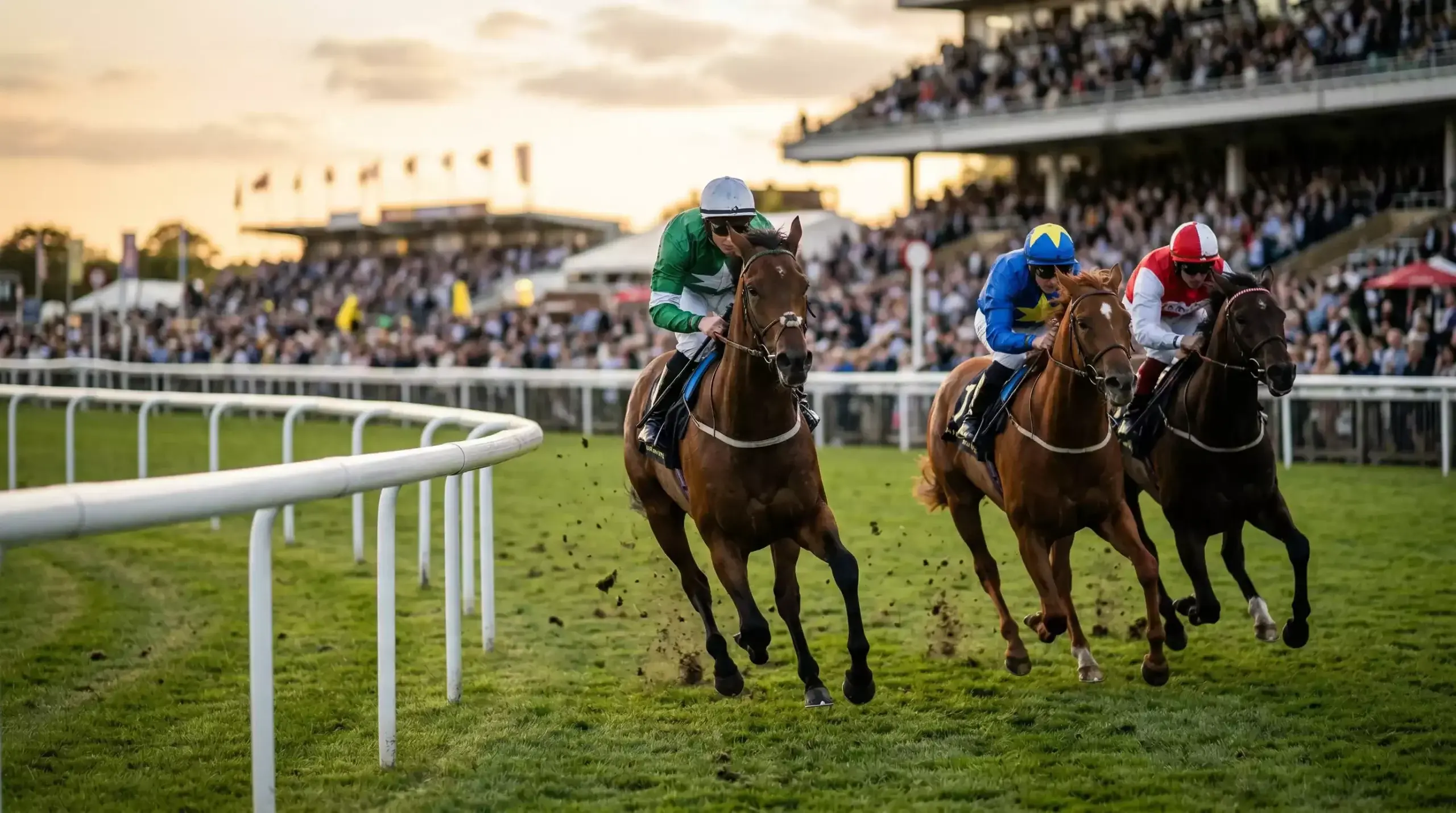

This guide is built on the numbers behind those headlines.
I placed my first horse racing bet on a damp Wednesday afternoon at Kempton Park, armed with nothing but a tip from a bloke in the queue and a tenner I could not really afford to lose. The horse finished fourth. The bloke had already left. That was nine years ago, and since then I have spent most of my working life buried in racecards, form databases and Gambling Commission spreadsheets — trying to turn what most people treat as a flutter into something closer to informed decision-making.
Horse racing betting in the UK is not a niche hobby. Remote wagering on the sport generated £766.7 million in gross gambling yield in the year to March 2025, making it the second-largest betting vertical after football. Racecourse attendance crossed five million for the first time since 2019, hitting 5.031 million in 2025. Between four and seven per cent of British adults place a bet on the horses in any given month, depending on where we are in the racing calendar — peaking around Cheltenham and Royal Ascot, dipping in the autumn.
This guide is built on the numbers behind those headlines. Every claim you will read here traces back to the Gambling Commission, the British Horseracing Authority, the Horserace Betting Levy Board or verified industry data. I have structured it as a walk-through: the market landscape, how betting actually works, odds mechanics, strategic frameworks, bookmaker selection, the regulatory environment and where the whole thing is heading. Whether you are sizing up your first each-way or refining a staking plan you have been running for years, the data should do the heavy lifting — not opinion, not gut feeling.
£766.7m
Remote horse racing GGY, year to March 2025
4-7%
UK adults betting on horse racing in any given month
5.031m
Racecourse attendance in 2025 — highest since 2019
The Numbers, Strategies and Rules That Shape Every Wager
- UK horse racing betting generated £766.7 million in remote GGY in the year to March 2025, yet total turnover has fallen 12.8% since 2023 — understanding why matters for where the market is heading.
- Fractional odds, each-way terms and Best Odds Guaranteed are mechanics you need to grasp before staking real money; this guide walks through each with worked examples.
- Value betting and disciplined bankroll management outperform gut-driven punting over any meaningful sample — the maths is straightforward once you see it.
- Affordability checks now trigger at £150 net monthly deposits, reshaping how regulated bookmakers interact with punters at every level.
- Choosing a bookmaker is a data exercise: market depth, early prices, BOG policies and streaming coverage vary more than most bettors realise.
UK Horse Racing Betting Market in Numbers
The first spreadsheet I ever pulled from the Gambling Commission's data portal stopped me mid-scroll. I had expected horse racing to sit somewhere behind football, tennis, maybe even cricket in the betting hierarchy. It does sit behind football — but closer than most people assume, and the gap tells you something about how deeply embedded racing is in the British betting ecosystem.
Remote betting on horse racing returned £766.7 million in gross gambling yield for the financial year ending March 2025. To put that in context, the entire UK gambling industry pulled in £16.8 billion GGY in 2025, with the remote betting, casino and bingo segment contributing £7.8 billion. Within remote betting alone, football led at £1.3 billion GGY; horse racing's £766.7 million made it the clear second. No other single sport comes close to that figure.
£766.7 million
Remote horse racing GGY in the year to March 2025 — second only to football in UK betting verticals.

But here is the complication. While the headline GGY figure looks robust, turnover is moving in the opposite direction. Betting turnover on British racing fell 9% in Q1 2025 compared with the same period in 2024. Extend the lens, and the picture sharpens further: total turnover across the first nine months of 2025 dropped 4.2% year-on-year and 12.8% against 2023. The average amount wagered per race at core fixtures — your standard midweek cards — declined by 14.4%, though premier fixtures held steady. Richard Wayman, the BHA's Director of Racing, noted that while the racing product itself needs work to grow its appeal as a betting medium, a much wider range of factors was contributing to the decline.
IBISWorld pegs the broader UK horse and sports betting market at £3.7 billion in 2026, spread across 499 companies, with a compound annual growth rate of -3.9% over the five years to 2025. That negative CAGR is not a misprint. The industry is contracting in real terms even as individual metrics — like the HBLB's record levy collection — flash green.
The economic footprint of British racing extends well beyond the bookmaker's margin. The BHA's evidence to Parliament puts the figure at £4.1 billion in direct, indirect and associated expenditure annually, supporting over 20,000 jobs across 59 racecourses, more than 500 training yards and 660 breeding operations. When the turnover line drops, the ripple reaches stable staff, groundskeepers and local economies that most punters never think about when tapping a betslip.
£16.8bn
Total UK gambling industry GGY in 2025
-12.8%
Racing turnover decline, 9 months of 2025 vs 2023
£4.1bn
Annual economic footprint of British racing
20,000+
Direct jobs supported by the racing industry
For punters, these numbers are not abstract. A shrinking turnover pool affects liquidity in betting markets, which in turn affects the odds you are offered and the speed at which prices move. Understanding the shape of the market — where the money comes from, where it is going, and what is pulling it away — is the first step in betting with your eyes open rather than closed.
How Horse Racing Betting Works
A colleague once told me she had spent twenty minutes staring at a betslip screen before closing the app entirely, not because she did not want to bet, but because she could not work out what half the fields meant. She is not alone. The mechanics of placing a horse racing bet are genuinely simple once somebody walks you through them, but the industry has a talent for burying simplicity under jargon and cluttered interfaces.
At its core, betting on a horse race means selecting a horse, choosing a bet type, deciding your stake, and confirming the wager. The bookmaker then calculates your potential return based on the odds attached to that horse at the time you place the bet — or, if you take Starting Price, at the moment the race begins. Over 80% of bets placed at Cheltenham Festival 2024 were made through mobile devices, which tells you where the action has migrated: the process is overwhelmingly digital, even if the spectacle remains gloriously physical.
Anatomy of a betslip
A standard betslip contains four elements: Selection (the horse you are backing), Bet type (win, each-way, forecast, etc.), Stake (how much you are wagering) and Potential return (stake multiplied by odds, minus the stake for profit). Some slips also show an "each-way terms" line if you have toggled e/w, displaying the place fraction and number of places paid.

If you want a thorough walkthrough of every step from opening an account to confirming your first wager, I have written a dedicated step-by-step guide to betting on horse racing that covers the lot. What follows here is the structural overview — bet types, the racecard-to-betslip pipeline and where new punters typically get tripped up.
Core Bet Types: Win, Each-Way, Accumulators and More
The simplest bet in horse racing is a win single. You pick one horse. If it wins, you collect. If it does not, you lose your stake. Everything else in the bet-type catalogue is a variation on that foundation — adding complexity, risk and, occasionally, reward.
| Feature | Win Single | Each-Way |
|---|---|---|
| Stake structure | One unit on win | Two units — one on win, one on place |
| Pays out when | Horse finishes first | Horse finishes first (both parts) or in a place position (place part only) |
| Place terms | N/A | Typically 1/4 or 1/5 of win odds, 2-4 places depending on field size |
| Risk profile | Higher risk, higher reward per unit staked | Lower risk, but double the total stake |
| Best suited for | Short-priced selections, strong confidence | Bigger-priced horses in large fields |
Each-way betting is arguably the most misunderstood wager in UK racing. The critical thing to remember is that it is two bets, not one. A £5 each-way bet costs £10 total. If your horse wins, both the win part and the place part pay out. If it finishes second or third (or fourth, in handicaps with 16+ runners), only the place part pays — at a fraction of the win odds. I have a full breakdown of how to calculate each-way returns and when the bet makes mathematical sense.
Accumulator (acca) — a single bet linking two or more selections across different races. All selections must win for the bet to pay out. The odds multiply together, creating large potential returns from small stakes, but the probability of landing an acca drops sharply with each added leg.
Beyond singles and each-way, you will encounter forecasts (predicting first and second in order), tricasts (first, second and third), and combination bets like Yankees and Lucky 15s that bundle multiple doubles, trebles and accumulators into a single slip. For the purpose of this guide, the two you need to understand first are the win single and the each-way — they account for the vast majority of horse racing bets placed in the UK.
From Racecard to Betslip: Placing Your First Wager
Every race you can bet on has a racecard — a structured summary of each runner's form, trainer, jockey, weight carried, draw position (on the flat) and recent results. The racecard is your starting point, not the odds. I say this because the most common mistake I see from new punters is scanning the odds column first and reverse-engineering a justification for backing the horse with the "best" price. That is backwards.
Before you place a bet — five checks
- Read the racecard: check form figures, trainer strike rate, jockey booking and going preference.
- Assess the conditions: what is the ground (firm, good, soft, heavy)? Does your selection handle it?
- Look at the market: is the price shortening (money coming for it) or drifting (money moving away)?
- Set your stake: decide the amount before you open the betslip, not after you see the potential return.
- Confirm bet type: win only or each-way? Match the bet to the race — large handicap fields favour each-way; small fields often do not.
Example: placing a £10 each-way bet at 8/1
Total stake: £20 (£10 win + £10 place).
If the horse wins: Win return = £10 x 8/1 = £80 + £10 stake = £90. Place return (1/4 odds) = £10 x 2/1 = £20 + £10 stake = £30. Total return = £120. Profit = £100.
If the horse places (but does not win): Place return only = £30. Total profit = £10 (£30 return minus £20 total stake).
The racecard-to-betslip process is mechanical once you have done it a few times. The skill lies not in navigating the interface but in what you do before you get there — reading form, understanding conditions and pricing up the race in your own mind before you look at what the bookmaker thinks.
How Horse Racing Odds Work in the UK
I spent an embarrassing amount of time early on treating odds as a ranking system — shorter price means better horse, longer price means worse horse. That is roughly how the public reads them, and it is roughly how a lot of people lose money. Odds are not a quality score. They are a price, and like any price, they can be wrong.
In the UK, horse racing odds are traditionally expressed as fractions. A horse quoted at 5/1 ("five to one") returns five units of profit for every one unit staked, plus the original stake back. At 2/1, you double your money plus your stake. At 1/2 ("odds on"), you need to stake two units to profit one. The fraction tells you the ratio of profit to stake — nothing more.

Fractional to decimal to implied probability
Fractional: 4/1. Decimal: 5.00 (add 1 to the fraction — 4 divided by 1, plus 1). Implied probability: 1 / 5.00 = 0.20, or 20%.
Fractional: 6/4. Decimal: 2.50 (6 divided by 4 = 1.5, plus 1). Implied probability: 1 / 2.50 = 0.40, or 40%.
Fractional: 1/3. Decimal: 1.33 (1 divided by 3 = 0.33, plus 1). Implied probability: 1 / 1.33 = 0.75, or 75%.
Decimal odds, favoured by exchanges and increasingly by online bookmakers offering a toggle, fold the stake into the number. A decimal price of 5.00 means a £1 bet returns £5 total (£4 profit plus the £1 stake). The conversion from fractional to decimal is straightforward: divide the first number by the second, add one. Implied probability is then simply one divided by the decimal odds. These conversions matter because they let you compare odds across formats and, more importantly, against your own estimate of a horse's chances. If you want to dig deeper into how prices are set, how the overround works and what moves odds in the minutes before a race, I have covered the mechanics in detail in my guide to horse racing odds.
Converting a full market to implied probabilities
Suppose a five-runner race is priced: Horse A 2/1, Horse B 3/1, Horse C 5/1, Horse D 8/1, Horse E 10/1.
Implied probabilities: A = 33.3%, B = 25.0%, C = 16.7%, D = 11.1%, E = 9.1%.
Sum = 95.2%. But probabilities should sum to 100%. The gap — or more accurately, the excess if we had more runners or tighter prices — is the bookmaker's overround, the built-in margin that ensures the book turns a profit regardless of the result. A "fair" book runs at 100%; most UK horse racing markets sit between 110% and 125%, depending on the race and the bookmaker.
Starting Price, BOG and Why They Matter
Starting Price — SP — is the official odds returned on a horse at the moment the race begins, determined by on-course bookmakers and verified by an independent adjudicator. If you take SP rather than a fixed price, your return depends entirely on what the market does between the time you place your bet and the off. Some punters prefer it because it removes the guesswork of timing; others avoid it precisely because it removes control.
Best Odds Guaranteed (BOG) — a promotion offered by most major UK bookmakers that pays you the higher of the fixed price you took and the SP. If you back a horse at 4/1 and the SP drifts to 6/1, you receive 6/1. If the SP shortens to 3/1, you still get your original 4/1.
The scale of BOG payouts is staggering. At Cheltenham Festival 2026 alone, one major bookmaker paid out over £50 million in BOG enhancements. That figure tells you two things: first, that prices do move significantly between early markets and the off; second, that BOG is not a gimmick — it has measurable financial value for punters who take early prices on horses whose SP drifts outward.
BOG policies vary by operator. Some cap the maximum enhancement, others exclude certain race types or restrict it to UK and Irish racing. Checking the specific terms before you stake is a habit worth building — the headline "Best Odds Guaranteed" means less than the fine print underneath it.
Flat Racing vs National Hunt: What Changes for Bettors
The first time I watched a novice chase at Sandown after a summer spent entirely on the flat, it felt like switching from chess to boxing. Same board, completely different game. The two codes of British racing — flat and National Hunt (jumps) — operate under the same regulatory umbrella and use the same bookmakers, but the betting dynamics diverge in ways that matter for your approach, your staking and your strike rate.
| Factor | Flat Racing | National Hunt |
|---|---|---|
| Season | April to October (turf); year-round (all-weather) | October to April (core); some summer jumping |
| Obstacles | None | Hurdles (smaller) or fences (steeplechase) |
| Typical distances | 5 furlongs to 2 miles 4 furlongs | 2 miles to 4+ miles |
| Field sizes | Often 8-20 runners; big handicaps 20+ | Typically 6-16 runners; some large handicaps |
| Key variables | Draw, going, speed figures, weight | Jumping ability, stamina, going, course form |
| Favourite win rate | Higher in small-field Group races | Lower overall; fallers and unseated riders add variance |
| Marquee events | Royal Ascot, the Derby, Champions Day | Cheltenham Festival, Grand National, King George |

From a punting perspective, the single biggest difference is variance. National Hunt racing introduces jumping as an independent source of failure. A horse can be travelling beautifully, two lengths clear at the second-last, and then clip the top of the fence and unseat its rider. No amount of form study eliminates that risk. This is why many experienced jumps punters lean toward each-way betting in competitive handicaps — the place part of the bet acts as an insurance policy against the randomness of obstacles.
Flat racing, by contrast, tends to produce more predictable outcomes in small-field conditions races and Group events. The draw — the starting stall position — becomes a variable you simply do not encounter over jumps, and at certain courses (Chester, Beverley, Musselburgh) it is the single most significant factor. BHA data shows that 87.6% of races in Q1 2025 started within two minutes of their scheduled time, up from 79.2% in 2024, which matters more for in-play bettors on the flat where seconds count.
If you are interested in how these differences translate into specific betting adjustments — staking, odds assessment, market timing — the dedicated flat vs National Hunt breakdown goes deeper. The summary here is simple: treat the two codes as different sports that share a venue. Your approach to one should not be copy-pasted onto the other.
Understanding the structural differences between flat and jumps is the groundwork. The next question is what you actually do with that knowledge — which brings us to strategy.
Betting Strategies That Use Data, Not Gut Feeling
There is a moment every punter hits — usually after a string of losses that felt like bad luck — where you sit down and realise you have no system. You have opinions. You have hunches. You have a vague preference for horses trained by certain people. But you do not have a method. That moment is either the beginning of better results or the start of a longer, more expensive version of the same mistakes.
The turnover data I covered in the market section reveals a telling split: while overall volumes are shrinking, the average wagered per race at premier fixtures has held steady. The casual money is leaving, but the serious money is not. If you want to be on the right side of that divide, you need an approach that can be tested, measured and adjusted — not just felt.
Do
- Price up a race before you look at the bookmaker's odds — your independent assessment is the foundation of value identification.
- Keep a record of every bet: selection, odds taken, stake, result, profit or loss. Without data, you cannot evaluate your method.
- Separate your betting bankroll from your day-to-day finances. This is not a budgeting tip; it is a psychological boundary.
- Focus on races you have genuinely studied rather than betting every race on the card.
Don't
- Chase losses by increasing stakes after a losing run. The maths does not support it; your bankroll will not survive it.
- Rely on tips without understanding the reasoning behind them. A tip is someone else's opinion; value is a measurable discrepancy.
- Back short-priced favourites as a "safe" strategy. Favourites win roughly 30% of races — the other 70% of the time, you lose.
- Ignore the overround. A bookmaker with a 125% book is taking 25% more margin than a fair market; that margin comes from your returns.

For a comprehensive framework covering multiple strategy types — dutching, laying, speed figures, trainer angles — I have built a detailed walkthrough in the horse racing betting strategy guide. Below, I will outline two core principles that underpin every effective approach: expected value and bankroll management.
Identifying Value: Expected Value in Practice
Value, in betting, has a precise definition. A bet has positive expected value (+EV) when the probability you assign to an outcome is higher than the probability implied by the bookmaker's odds. That is it. If you believe a horse has a 25% chance of winning and the bookmaker is offering odds that imply a 20% chance (4/1), the bet has positive expected value. Over a large enough sample, backing +EV bets produces a profit. Over a small sample, anything can happen — which is why patience and record-keeping are non-negotiable.
Expected value calculation
Your assessed probability of Horse X winning: 30% (0.30).
Bookmaker's odds: 7/2 (decimal 4.50), implying a 22.2% chance.
EV = (0.30 x 3.50) - (0.70 x 1.00) = 1.05 - 0.70 = +0.35.
For every £1 staked, the expected return is +£0.35 in the long run. This is a value bet.
Now suppose the odds shorten to 2/1 (decimal 3.00), implying 33.3%. Your assessed probability is 30%.
EV = (0.30 x 2.00) - (0.70 x 1.00) = 0.60 - 0.70 = -0.10.
The same horse, at shorter odds, is no longer a value proposition. The price changed; the horse did not.
The hard part is not the arithmetic — it is the probability assessment. That is where form analysis, going knowledge, trainer patterns and course data come in. The expected value framework simply gives you a way to decide whether the price on offer justifies the risk. Without it, you are essentially decorating randomness with conviction.
Bankroll Principles Every Punter Should Know
I have met punters with excellent judgement who are perpetually broke. Not because they pick bad horses, but because they have no relationship between their confidence in a selection and the amount they stake on it. Bankroll management is the mechanism that keeps you in the game long enough for your edge — if you have one — to materialise.
The simplest viable rule: never stake more than 2-5% of your total bankroll on a single bet. If you are working with a £500 bankroll, that means individual stakes between £10 and £25. This feels conservative when you are on a winning run and painful when you are not — which is exactly the point. It prevents both over-confidence and desperation from dictating your decisions.
More sophisticated approaches exist. Fixed-percentage staking adjusts your stake in proportion to your bankroll — as it grows, stakes rise; as it shrinks, stakes fall. The Kelly Criterion calculates an "optimal" stake based on your estimated edge and the odds, maximising long-run growth. In practice, most professionals use a fractional Kelly (half or quarter of the calculated stake) to account for the reality that probability estimates are never perfectly accurate. The principle behind all of these methods is identical: protect the bankroll first, maximise returns second.
How to Choose a Horse Racing Bookmaker
I change my primary bookmaker roughly every eighteen months, and I maintain active accounts with five. That sounds excessive until you realise that the difference between the best available odds and the average on any given race regularly exceeds 10% — and over a year of serious betting, that margin is the difference between a small profit and a notable loss. Choosing a bookmaker is not a loyalty decision. It is an odds-shopping strategy.
The UK licensed betting market is competitive. William Hill alone captured 37.83% of pay-per-click advertising impressions in the sports betting category in February 2026, with bet365 at 16.2%. But advertising spend does not correlate with value for punters. What does correlate is a handful of measurable factors that separate good racing bookmakers from adequate ones.
| Selection criterion | What to look for | Why it matters |
|---|---|---|
| Early prices | Odds available the day before or morning of the race, not just at the off | Early prices give you the chance to lock in value before the market tightens |
| Best Odds Guaranteed | BOG available on UK and Irish racing with no payout cap | Ensures you always receive the better of your fixed price and SP |
| Market depth | Odds offered on all UK and Irish races, not just feature events | Serious punters bet midweek cards and evening meetings, not just Saturdays |
| Place terms on each-way | Extra places offered on big-field handicaps; 1/4 odds as standard | Enhanced place terms on certain races can shift the each-way edge significantly |
| Live streaming | Races streamed within the app or site with no additional login | Watching the race you have bet on is both practical (in-play decisions) and essential for form study |
| Account restrictions | Operator's track record for limiting or closing winning accounts | A bookmaker who stakes-limits you after a few profitable weeks is not a long-term option |
None of these factors involves the bookmaker's brand, their television adverts or the size of their welcome offer. Welcome offers are a one-time event; the criteria above affect every bet you place for as long as you hold the account. I have put together a broader comparison of horse racing betting sites in the UK that goes deeper into each of these dimensions.
The best bookmaker for horse racing is the one offering the best price on the horse you want to back, today, in this race. Maintaining accounts with multiple operators and checking odds across them before you stake is the single most reliable way to improve your long-term returns without changing anything about your selection process.
UKGC, the Levy and How Regulation Shapes Your Betting
Most punters think about regulation the way most drivers think about traffic law: it exists, it probably matters, and they would rather not deal with it until they have to. I get that. But here is the thing — regulation is not a background condition in UK horse racing betting. It is an active force that determines which bookmakers you can use, how much you can deposit without triggering checks, what tax the operator pays (and therefore what margin it builds into odds) and how the sport itself gets funded. Ignoring it does not make you a free spirit; it makes you uninformed.
The UK Gambling Commission (UKGC)
The UKGC licenses and regulates all commercial gambling in Great Britain. Any bookmaker accepting bets from UK customers must hold a UKGC licence. The Commission sets standards for fair play, consumer protection and responsible gambling, and has the power to fine or revoke licences for non-compliance. It does not set odds, does not recommend operators and does not guarantee your winnings — it regulates the framework in which betting operates.
The financial architecture behind UK racing is unique. The Horserace Betting Levy Board collects a statutory levy from bookmakers based on their horse racing turnover — currently set at 10% of gross profits. In the year to March 2025, the HBLB collected a record £108.9 million, the highest figure since 2017. That money flows directly into the sport: £77.1 million allocated to prize money in 2026, £20.1 million to regulation and integrity, and £10.5 million to industry grants. Alan Delmonte, the HBLB's Chief Executive, has described levy funding as underpinning a substantial range of activities across the sport, covering everything from promotion to the welfare of horses and people.
£108.9 million
Record levy collected by the HBLB in the year to March 2025 — the highest since 2017. This funds prize money, integrity services and industry development.
The 2025 Budget introduced a significant tax shift for the broader gambling sector. Chancellor Rachel Reeves raised Remote Gaming Duty from 21% to 40%, explicitly citing the association of remote gaming with the highest levels of harm. Crucially, however, she excluded horse racing from the increase entirely, leaving the sport's operators on the existing 15% general betting duty plus the 10% levy. That exemption was not accidental — it reflected lobbying from within racing about the sport's economic contribution and its distinct risk profile compared with online casino products.
Affordability Checks: What Punters Need to Know
Since February 2025, the threshold for light-touch financial checks dropped from £500 net monthly deposits to £150. If you deposit more than £150 in a calendar month with a single operator, you may be asked to provide evidence that you can afford your level of gambling. The checks range from basic automated assessments (credit reference agency data) to more intrusive requests for bank statements or payslips at higher thresholds.
The £150 net monthly deposit threshold applies per operator. This means spreading deposits across multiple bookmakers may delay when checks are triggered, but does not eliminate the regulatory requirement. Enhanced checks — involving documentation such as bank statements — kick in at higher spending levels and are mandated by the UKGC for all licensed operators.
The impact on the racing industry has been severe and measurable. The Jockey Club estimates that affordability checks will cost the industry £250 million over five years. Richard Wayman of the BHA has pointed to the checks as a primary driver behind punters either stopping betting altogether or migrating to unlicensed operators that do not conduct them. One in three punters staking £1,000 or more per transaction reported using an unregulated site in the past 12 months, according to a Racing Post survey of 10,000 bettors.
For individual punters, the practical advice is straightforward: keep records of your deposits and be prepared for verification requests if you are a regular bettor. The checks are a reality of the current regulatory landscape, not a temporary measure. Whether they achieve their stated aim of reducing gambling harm while not driving activity underground remains one of the sharpest debates in UK racing — and one I will return to in the trends section below.
Where the Market Is Heading: 2026 Trends
Sit in any weighing room bar at a midweek fixture and the conversation loops through the same three anxieties: the black market is growing, turnover is falling, and nobody knows what the regulator will do next. These are not paranoid rumblings. They are reflections of data points that are reshaping British racing's relationship with betting in real time.
9%
Share of UK online gambling market held by unlicensed operators (H1 2025)
£379m
Estimated GGY generated by the unlicensed market in H1 2025
25m+
Potential new fans identified by BHA's Project Beacon research
The black market is no longer a fringe concern. Yield Sec estimates that unlicensed operators controlled 9% of the UK online gambling market in the first half of 2025, generating approximately £379 million in gross gambling yield. The Betting and Gaming Council's CEO, Grainne Hurst, has called these operators "parasite" businesses that pay no tax, do not contribute to the levy and have zero safer gambling obligations. An open letter signed by over 400 British racing leaders in early 2026 warned that additional regulation at this point would be a gift to the criminal underworld.
Meanwhile, the licensed sector is consolidating. Flutter Entertainment — parent of Sky Bet, Paddy Power and Betfair — reported global revenue of $15.91 billion in 2025, a 17% increase year-on-year. Its UK and Ireland online volume grew 15%. The biggest operators are getting bigger while total market turnover shrinks, which suggests the contraction is hitting smaller and mid-tier bookmakers hardest. For punters, that consolidation could eventually narrow the range of odds available in the market, reducing the benefit of odds-shopping.
On the demand side, the BHA's Project Beacon research has identified over 25 million potential new fans for the sport. The attendance figures I cited earlier — the first time past five million since 2019 — tell part of that story, and 68% of those coming through the gates were casual or first-time visitors. Yet online turnover has dropped by £1.6 billion over two years to March 2024, a figure that rises to £3 billion in real terms once inflation is factored in. The audience is growing physically but retreating digitally, which creates an odd tension: more people are going racing, fewer are betting on it remotely.
For the data-driven punter, the trend lines point to a market in transition. Regulatory pressure is pushing casual bettors out of the licensed ecosystem. The black market is absorbing some of that displaced activity. The sport is investing heavily in attracting new audiences through the live experience. And the operators who remain licensed are competing harder for the punters who stay, which means better tools, better streaming and — at least for now — competitive odds. The window for informed punters is open. How long it stays open depends on what happens next at the Gambling Commission.
With the strategic and regulatory landscape mapped, the questions below cover the practical details that new and intermediate punters ask most often.
Frequently Asked Questions About Horse Racing Betting
How do horse racing odds work in the UK?
Horse racing odds in the UK are traditionally displayed as fractions — 5/1, 3/1, 11/4 and so on. The first number represents the profit you stand to make for every unit of the second number that you stake. At 5/1, a £1 bet returns £5 profit plus your £1 stake back, giving a total return of £6. Most online bookmakers now offer the option to display odds in decimal format, where the stake is already included in the number: 5/1 fractional equals 6.00 decimal. To convert any fractional odds to implied probability, divide one by the decimal equivalent. So 5/1 (6.00) implies a 16.7% chance of winning. Understanding that odds represent a price — not a prediction of certainty — is the starting point for any informed approach to betting.
What is each-way betting and when should I use it?
An each-way bet is two bets in one: a win bet and a place bet, at equal stakes. If you place £5 each-way, your total outlay is £10 — £5 on the horse to win and £5 on the horse to place (typically finish in the top two, three or four depending on field size). The place part pays out at a fraction of the win odds, usually 1/4 or 1/5. Each-way betting makes most mathematical sense in large-field handicaps where your selection is at bigger odds — the place insurance gives you a return even if the horse does not win but runs competitively. In small fields of five or fewer runners, each-way is rarely worth it because the place fraction covers only two positions and the odds reduction leaves very little return on the place part.
What is Best Odds Guaranteed (BOG)?
Best Odds Guaranteed is a promotion offered by most major UK bookmakers. It means that if you take a fixed price on a horse and the Starting Price (SP) at the off is higher, you automatically receive the SP instead. If the SP is lower than the price you took, you keep your original, higher odds. BOG effectively removes the risk of taking an early price that subsequently drifts. It applies to UK and Irish racing at most operators, though caps and exclusions vary — some bookmakers limit the maximum BOG payout or exclude specific race types. Always check the operator's terms.
How do I choose the best horse racing betting site?
Start with the factors that affect your returns: the range of markets offered (all UK and Irish racing, not just feature meetings), the competitiveness of early prices, whether Best Odds Guaranteed is available without caps, the each-way place terms on big-field races, and the quality of live streaming. Account restrictions also matter — some operators limit or close accounts that show consistent profits. A UKGC licence is a baseline requirement, not a differentiator. The most practical strategy is maintaining accounts with several operators and checking odds across them before placing each bet.
What is the difference between flat racing and National Hunt?
Flat racing takes place on level courses without obstacles, typically over distances from five furlongs to about two and a half miles. The turf flat season runs from April to October, though all-weather fixtures continue year-round. National Hunt (jumps) racing involves either hurdles or steeplechase fences, runs over longer distances (two miles to four-plus miles) and has its core season from October to April, culminating at Cheltenham Festival in March. For bettors, the key difference is variance: jumps racing introduces falling and unseating as factors that form analysis cannot fully predict, which generally favours each-way approaches in competitive fields. Draw analysis, important on the flat, is irrelevant over jumps.
Is horse racing betting legal and regulated in the UK?
Yes. All commercial horse racing betting in the UK is regulated by the UK Gambling Commission under the Gambling Act 2005. Any bookmaker accepting bets from UK customers must hold a UKGC licence. The regulatory framework covers consumer protection, fair play, anti-money laundering and responsible gambling requirements. Additionally, a statutory levy — currently 10% of gross profits from horse racing — is collected from bookmakers by the Horserace Betting Levy Board and reinvested into the sport. Punters do not pay tax on their winnings; general betting duty is paid by the operator.
What are the most common bet types in horse racing?
The most common bet in UK horse racing is the win single — backing one horse to finish first. Each-way betting (a combined win and place bet) is the second most popular, particularly in big-field handicaps. Accumulators, which link multiple selections across different races, are popular for small-stake, high-return wagering but carry significant risk as every leg must win. Forecast bets (predicting first and second in the correct order) and tricast bets (first, second and third) offer higher payouts at lower probabilities. Combination bets like Lucky 15, Yankee and Trixie bundle multiple doubles, trebles and accumulators into a single slip. For most punters, singles and each-way bets are the foundation — they offer the clearest risk-reward profile and the simplest maths.
From Data Points to Betting Decisions
Nine years of staring at spreadsheets, racecards and Commission reports has taught me one thing above all: the punters who last are the ones who treat betting as an information problem, not a luck problem. The market overview tells you where the money is and where it is going. The odds mechanics tell you what price you are paying. The strategy frameworks tell you whether that price is worth paying. And the regulatory landscape tells you the rules of the game you are actually playing — not the one you imagine.
The UK horse racing betting market is in a transitional phase. Turnover is contracting, regulation is tightening, the black market is expanding and the live audience is growing while the digital audience shrinks. That combination creates both risk and opportunity. For the punter who approaches this sport with discipline, data and a willingness to adapt, the current environment is more navigable than it appears from the headlines.
Three principles worth carrying into every race: price up the market yourself before looking at bookmaker odds — your independent assessment is the only defence against built-in margins. Manage your bankroll with fixed rules, not impulse. And treat every bet as a data point in a long-term record, not a standalone event. The horses will surprise you. Your process should not.
